ICML 2026 main conference

Plug-and-Play Diffusion Meets ADMM: Dual-Variable Coupling for Robust Medical Image Reconstruction

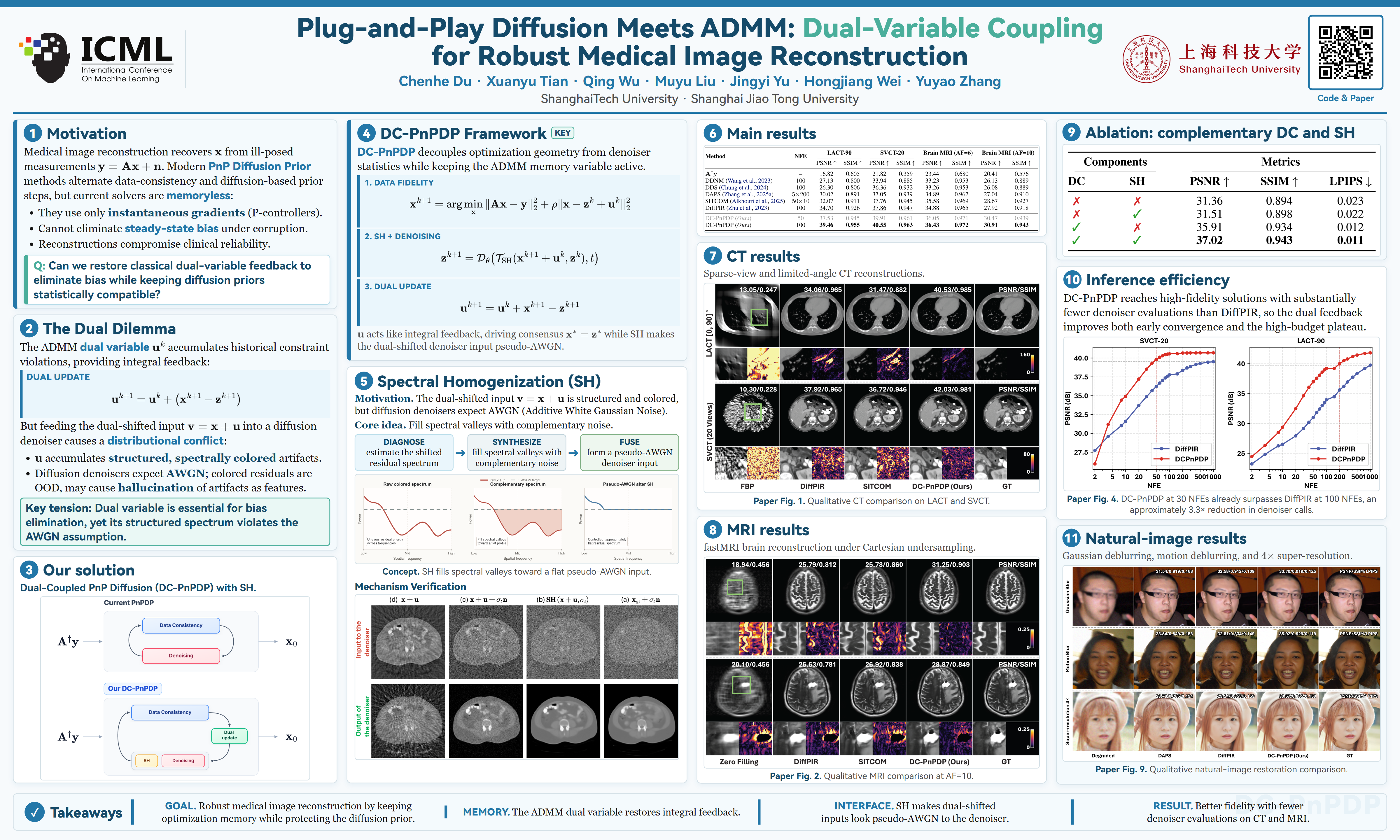
DC-PnPDP restores ADMM memory, then homogenizes dual-shifted denoiser inputs for pretrained diffusion priors.

Chenhe Du, Xuanyu Tian, Qing Wu, Muyu Liu, Jingyi Yu, Hongjiang Wei, Yuyao Zhang

ShanghaiTech University, Shanghai Jiao Tong University

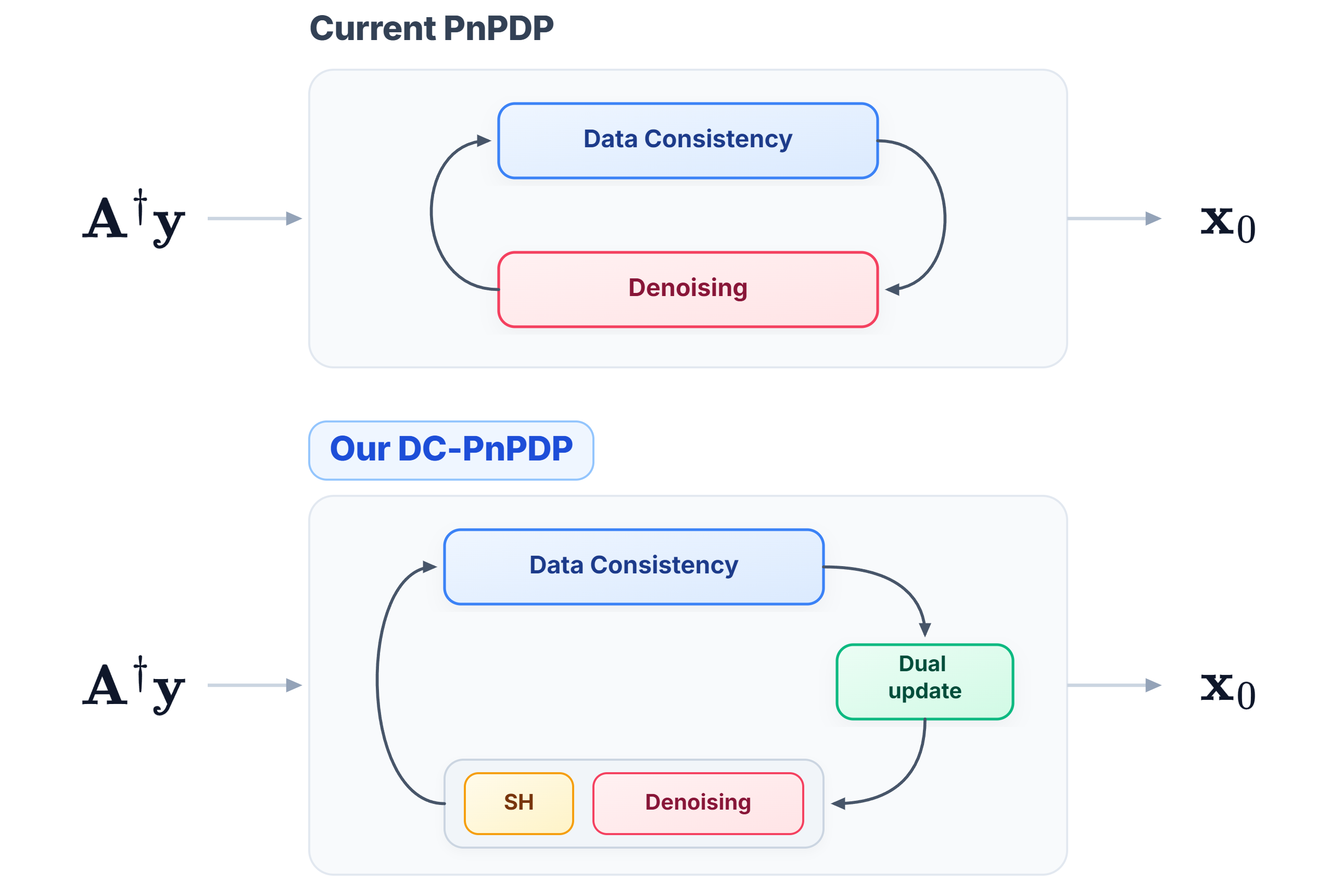
Conceptual comparison between current PnPDP and DC-PnPDP
Dual feedback removes bias. SH keeps the diffusion interface clean.
TL;DR

Classical ADMM memory is useful for reconstruction, but raw dual residuals violate the AWGN assumption of diffusion denoisers. DC-PnPDP couples the dual variable with a spectral correction layer.

Optimization memory helps, but diffusion priors need a clean interface

The method separates two roles: restore the feedback that removes bias, then reshape the denoiser input so pretrained diffusion priors remain reliable.

The bias-hallucination trade-off

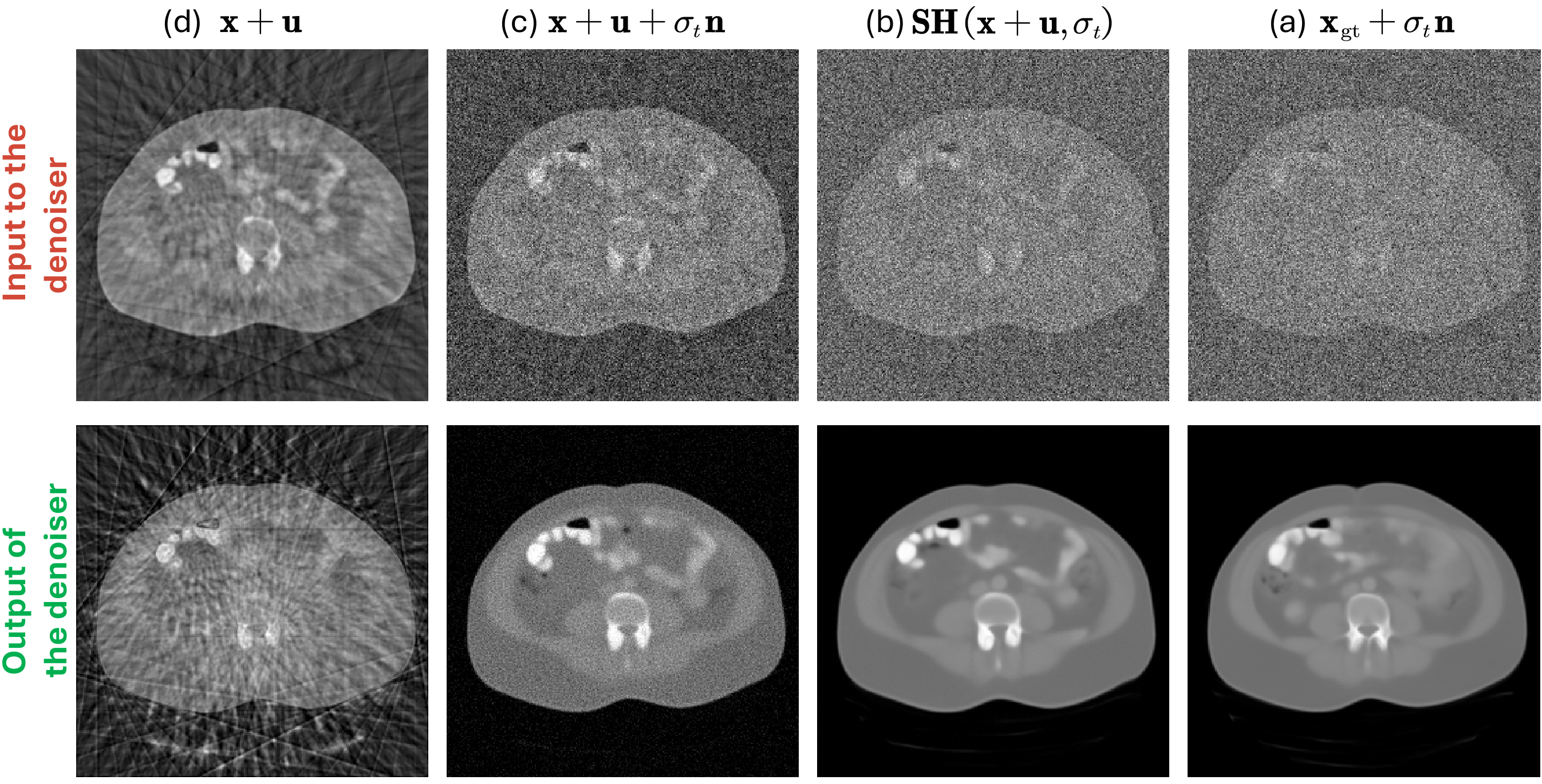
Memoryless PnP diffusion can leave a persistent data-consistency residual. Adding the ADMM dual variable fixes the bias, but the dual-shifted input becomes structured and spectrally colored.

DC-PnPDP keeps the dual feedback for optimization and applies Spectral Homogenization before denoising, avoiding the conflict between data fidelity and prior compatibility.
+4.76 dB

LACT-90 PSNR gain over the strongest baseline

+2.69 dB

SVCT-20 PSNR gain over the strongest baseline

3.3x

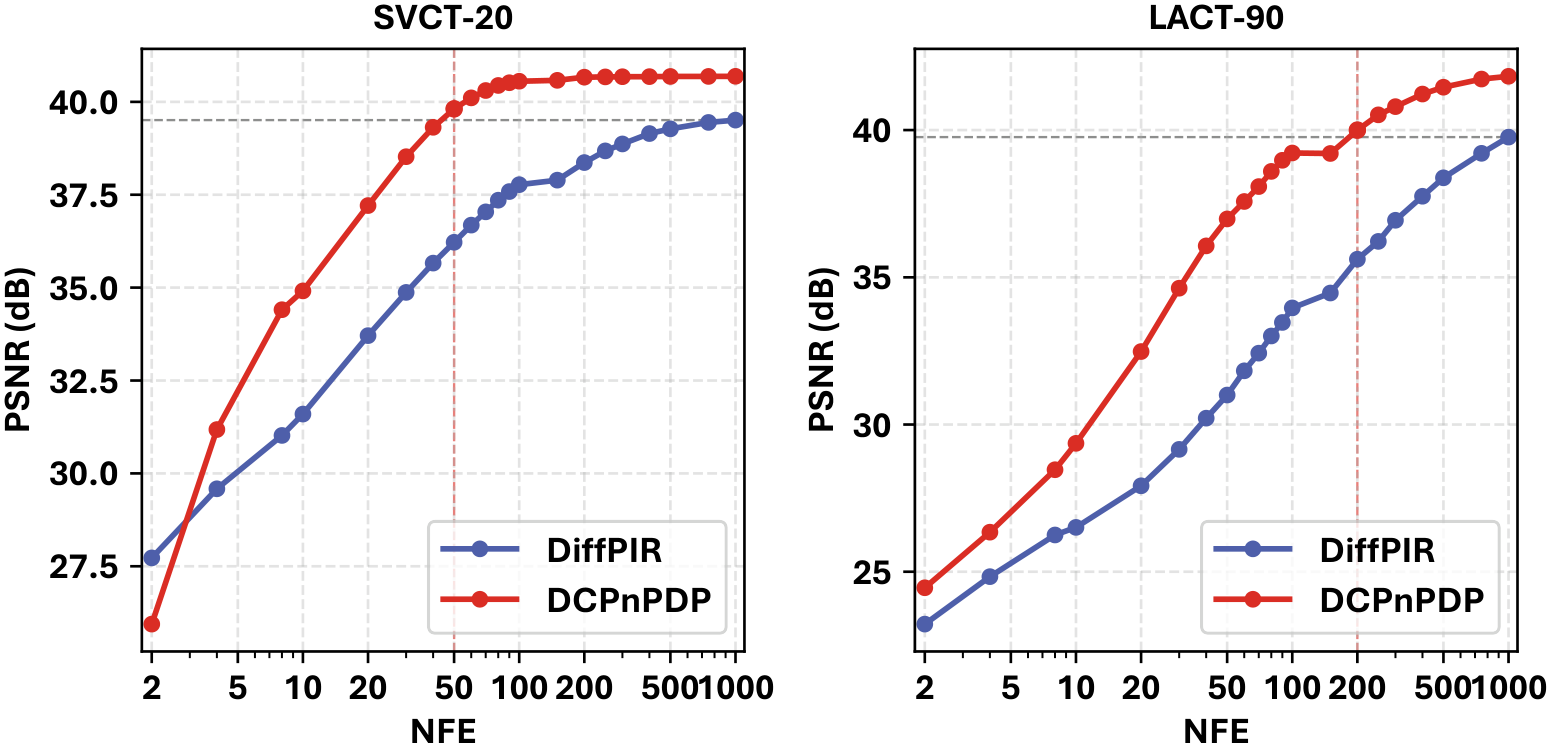
fewer denoiser evaluations at matched or better quality

1

Memoryless PnP diffusion can settle for bias

HQS or proximal-gradient PnP diffusion solvers update from instantaneous gradients and discard historical constraint violations.

2

ADMM dual feedback restores memory

The dual state accumulates consensus mismatch, acting as integral feedback that drives the data-consistency and prior variables toward agreement.

3

Spectral Homogenization protects the denoiser

SH reshapes structured, spectrally colored residuals so the diffusion denoiser receives a statistically compatible pseudo-AWGN input.

Dual-Coupled PnP Diffusion with Spectral Homogenization

DCPnP supplies the optimization memory. SH repairs the statistical interface seen by the denoiser.

Module 1: DCPnP

Restore ADMM dual-variable memory

DC-PnP keeps the scaled dual variable \( \mathbf{u} \) active, so the solver accumulates consensus error between \( \mathbf{x} \) and \( \mathbf{z} \) instead of relying only on instantaneous gradients.

The dual variable acts like integral feedback: it pushes the fixed point toward consensus \( \mathbf{x}^{*}=\mathbf{z}^{*} \), removing steady-state bias.

1 Data fidelity
\[ \mathbf{x}^{k+1} = \arg\min_{\mathbf{x}} \|\mathbf{A}\mathbf{x}-\mathbf{y}\|_2^2 + \rho\|\mathbf{x}-\mathbf{z}^{k}+\mathbf{u}^{k}\|_2^2 \]
2 SH + denoising
\[ \mathbf{z}^{k+1} = \mathcal{D}_{\theta}\!\left( \mathcal{T}_{\mathrm{SH}}(\mathbf{x}^{k+1}+\mathbf{u}^{k},\mathbf{z}^{k}),t \right) \]
3 Dual update
\[ \mathbf{u}^{k+1} = \mathbf{u}^{k} + \mathbf{x}^{k+1} - \mathbf{z}^{k+1} \]
Module 2: SH

Spectral Homogenization protects the diffusion prior

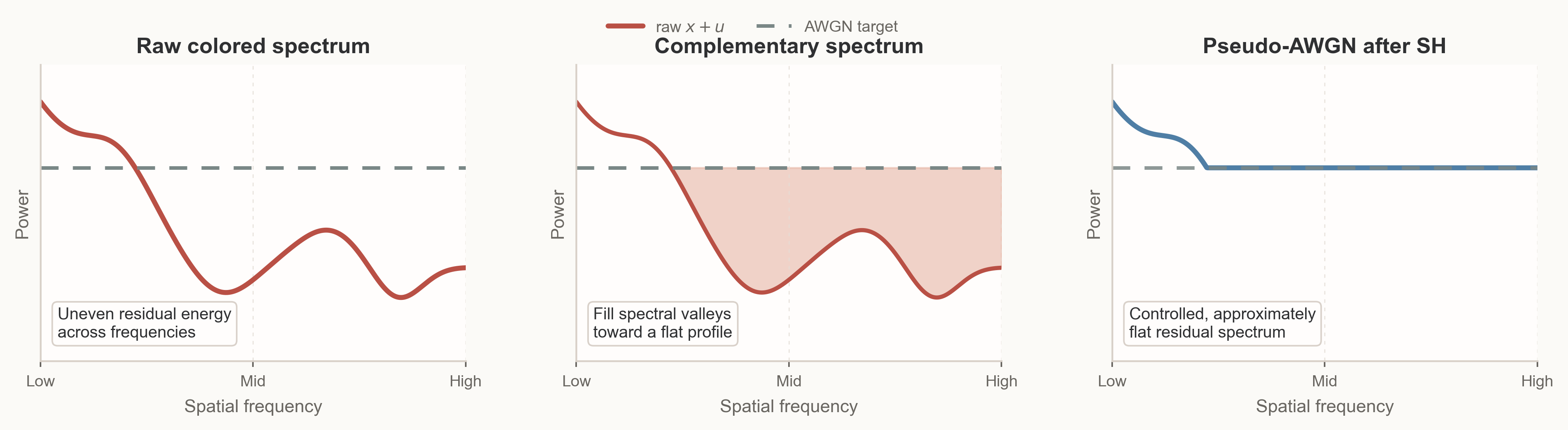
The dual-shifted input \( \mathbf{v}=\mathbf{x}+\mathbf{u} \) carries structured residuals from CT streaks or MRI aliasing. SH converts this interface into a pseudo-AWGN input before denoising.

Diagnoseestimate the shifted residual spectrum
Synthesizefill spectral valleys with complementary noise
Fuseform a pseudo-AWGN denoiser input
Spectral Homogenization schematic

Main Results

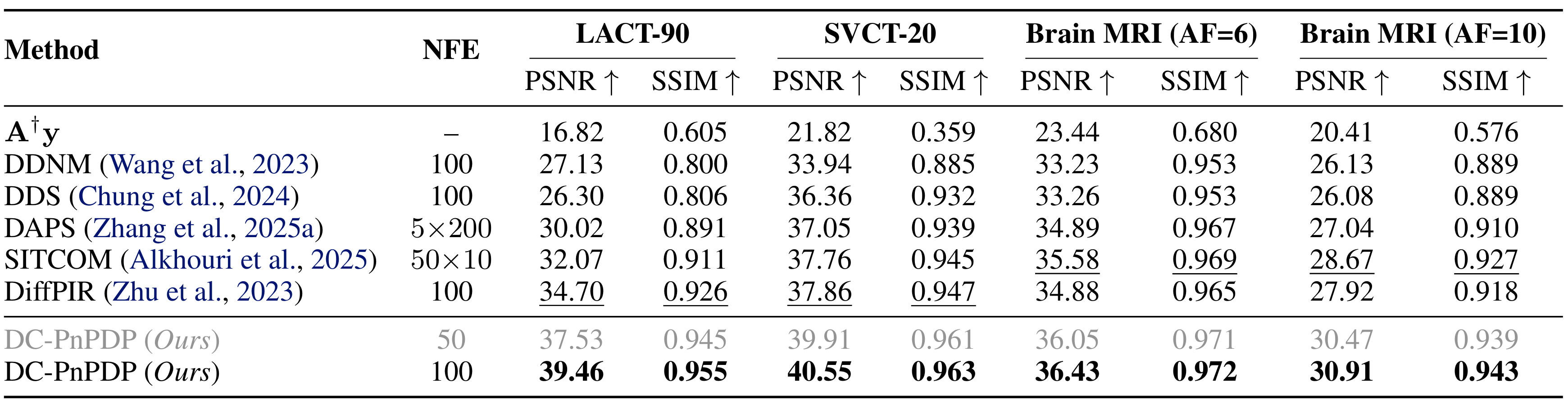
Main quantitative results

Main quantitative result table

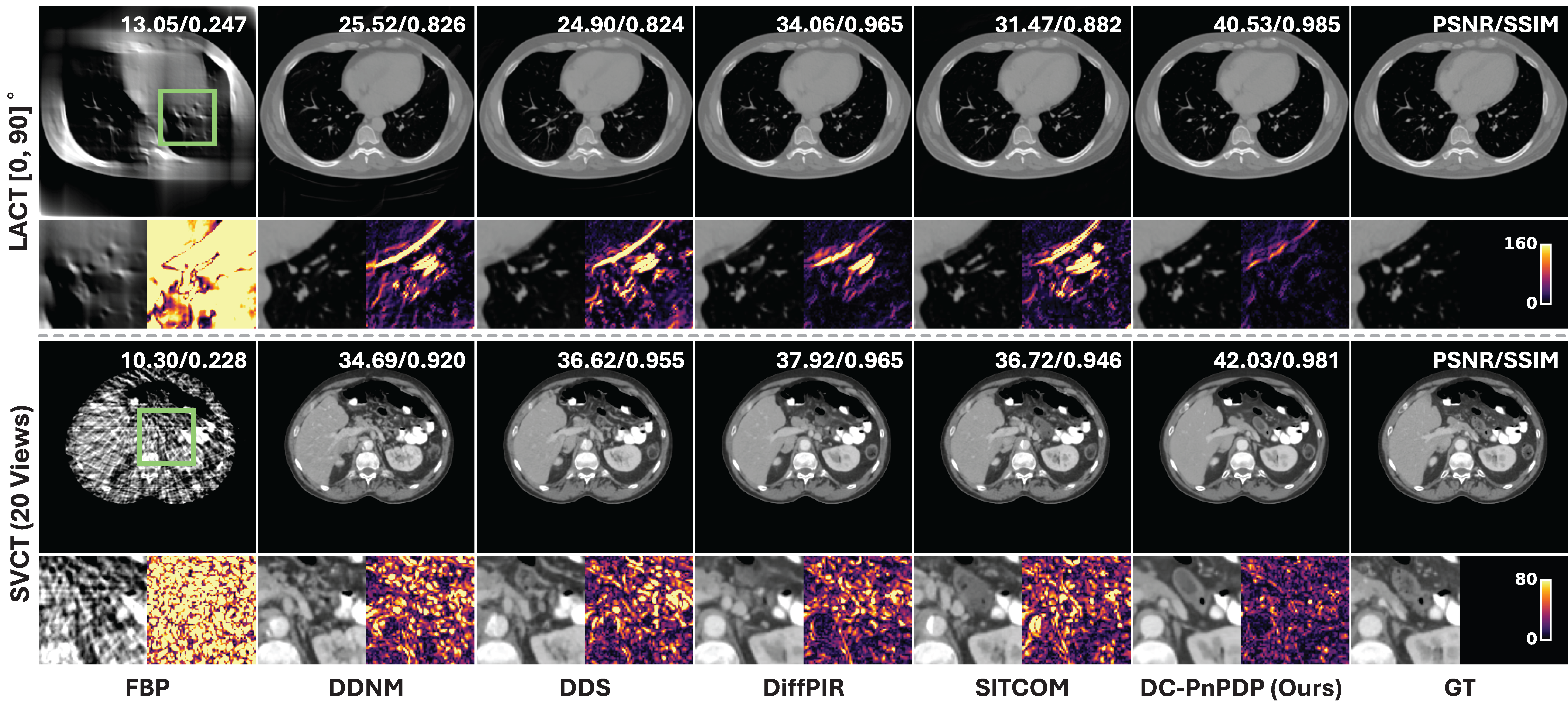
CT reconstruction

Qualitative CT reconstruction comparison

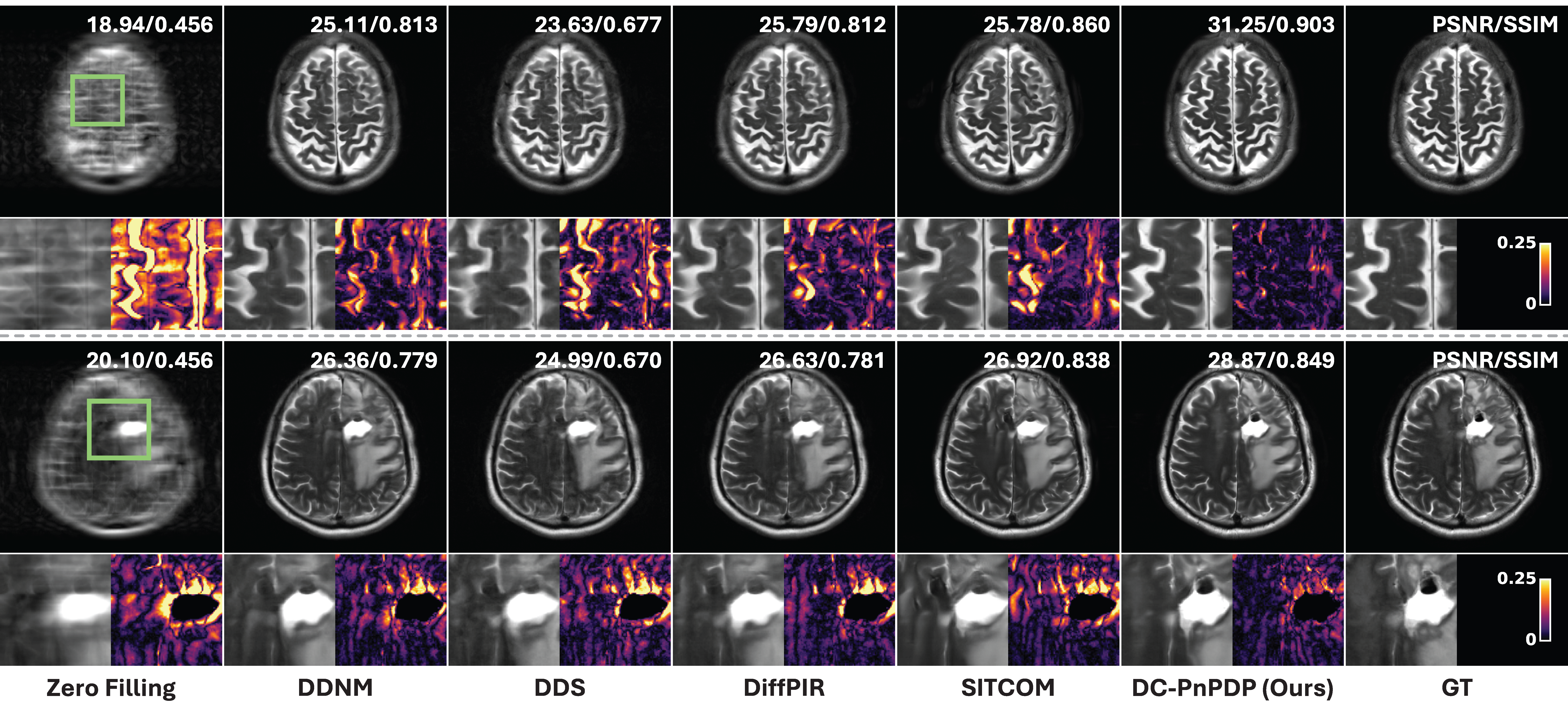
MRI reconstruction

Qualitative MRI reconstruction comparison

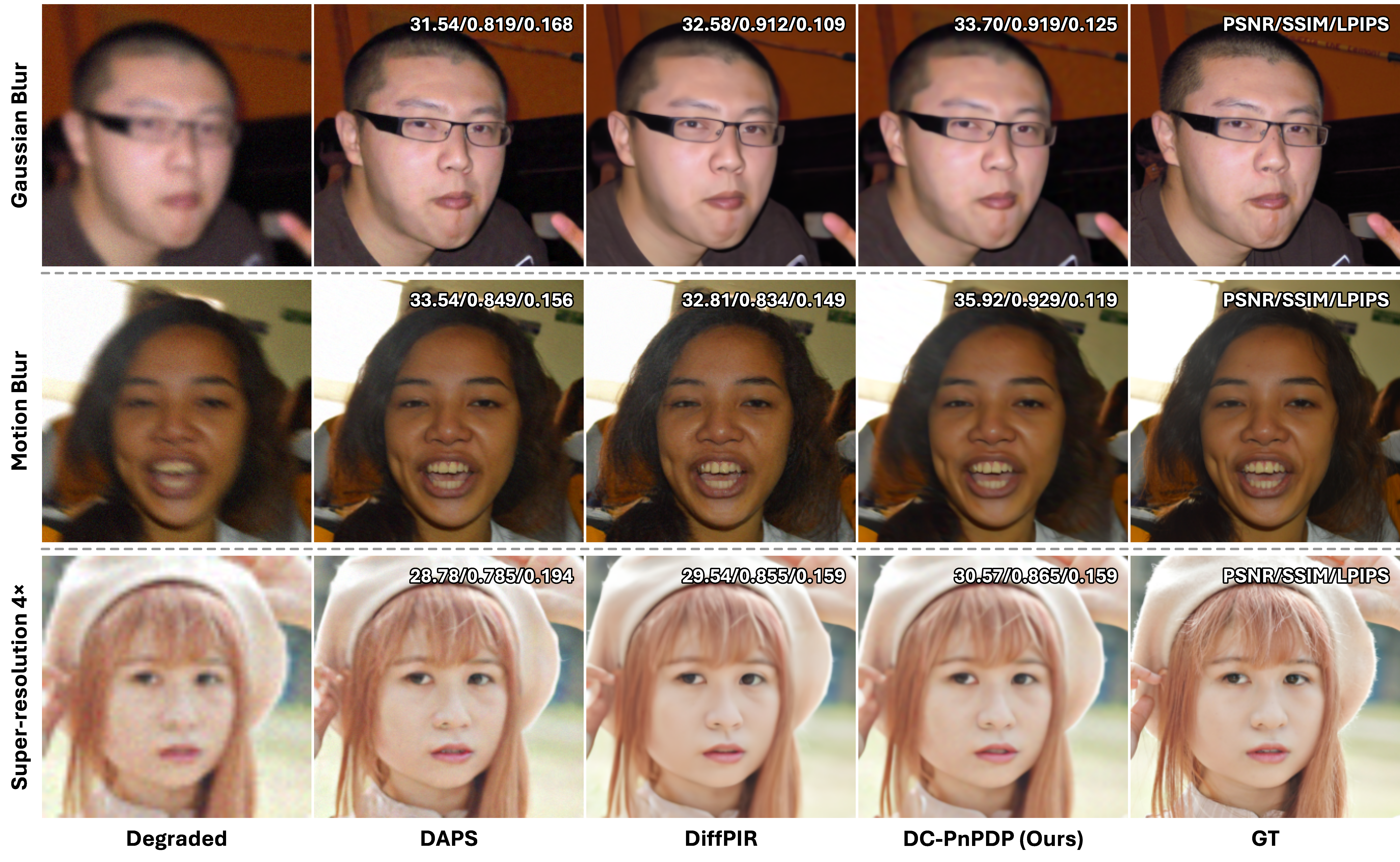
Natural-image restoration

Natural-image restoration comparison

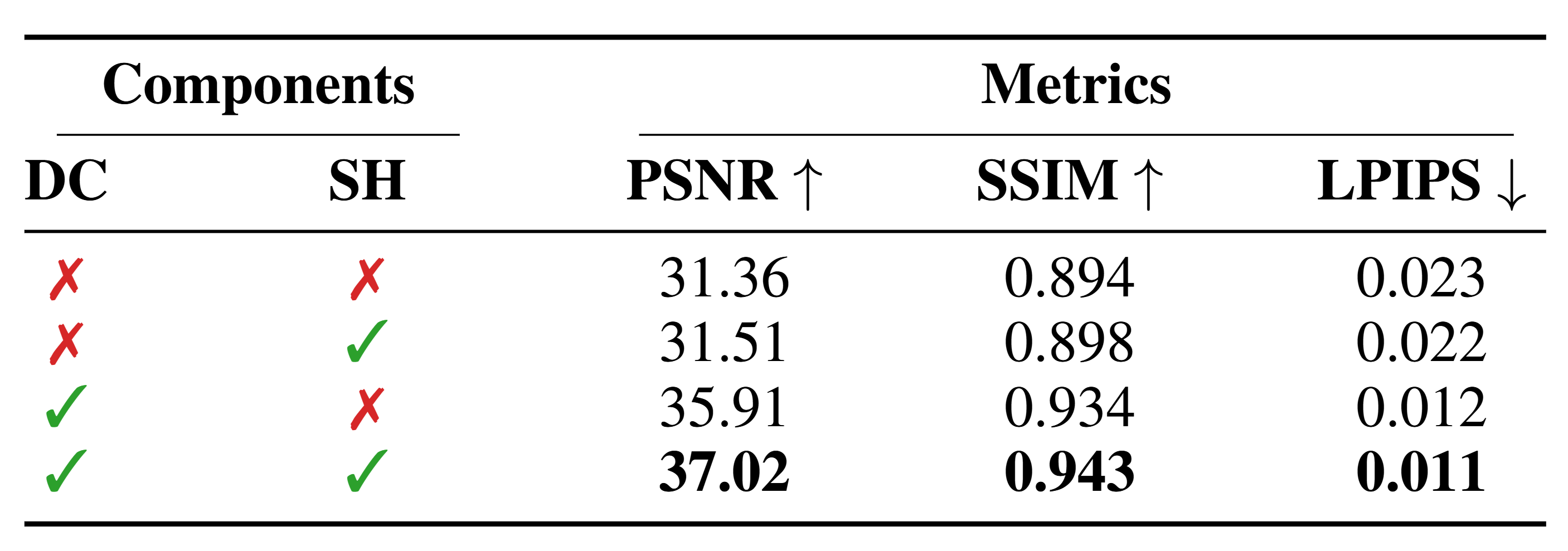
Ablation

Component ablation table

Inference efficiency

PSNR versus NFE inference efficiency curves

Cite DC-PnPDP

If you find this work interesting or helpful, please cite it.

@inproceedings{du2026dcpnpdp,
  title   = {Plug-and-Play Diffusion Meets ADMM: Dual-Variable Coupling for Robust Medical Image Reconstruction},
  author  = {Du, Chenhe and Tian, Xuanyu and Wu, Qing and Liu, Muyu and Yu, Jingyi and Wei, Hongjiang and Zhang, Yuyao},
  journal = {Forty-third International Conference on Machine Learning},
  year    = {2026},
  url     = {https://openreview.net/forum?id=jEBkuuETjr},
}